Testing
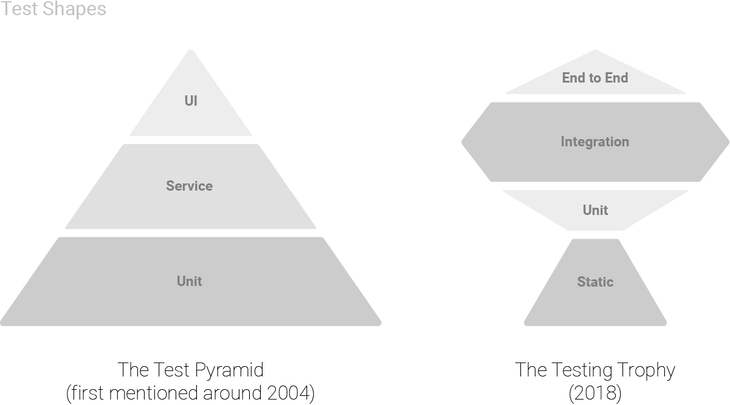
Tests are layered by scope: static checks (TypeScript, ESLint), unit tests of functions and modules in isolation, integration tests of several parts together (for UI: a component with its children, state and a mocked network), and end-to-end tests of the whole app in a real browser or device. The lower the layer, the faster and more stable the test; the higher, the more confidence it gives. The testing trophy puts the most weight on integration tests, the testing pyramid on unit tests. A good test checks behavior, not implementation, so it survives refactoring.
Applies to: Vitest 5, Jest 30, Playwright 1.64.
Details
Types of Tests
| Type | Checks | Speed | Tools (web) |
|---|---|---|---|
| Static | Types, syntax, style | Instant | TypeScript, ESLint |
| Unit | One function or module, dependencies replaced | ms | Vitest, Jest |
| Integration | Several units together, e.g. a form with its API calls mocked | ms–s | Vitest / Jest + Testing Library, MSW |
| E2E | User flows through the real app and backend | Seconds | Playwright, Cypress |
Tools
| Tool | Role |
|---|---|
| Vitest | Test runner on top of Vite, Jest-compatible API, native ESM and TypeScript |
| Jest | Test runner, the default in React Native; ESM and TS through transforms |
| MSW | Mocks the network at the request level, works in tests and in the browser |
| Playwright | E2E in Chromium, Firefox and WebKit, auto-waiting, parallel runs, traces |
| Cypress | E2E running inside the browser, interactive runner with time travel |
Component testing (Testing Library, queries, userEvent) is covered in
Testing React Components.
Test Doubles
| Double | What it is | Vitest / Jest |
|---|---|---|
| Stub | Returns canned answers, nothing is checked on it | vi.fn().mockReturnValue(…) |
| Spy | Records calls; may keep the real implementation | vi.spyOn(obj, 'method') |
| Mock | A double with expectations about how it is called | expect(fn).toHaveBeenCalledWith(…) |
| Fake | A working lightweight implementation: in-memory DB, fake timers | vi.useFakeTimers() |
Mock at the boundaries of the system (network, time, storage), not the code under test: the more is mocked, the less the test proves.
Coverage
- Shows which lines, branches and functions ran during the tests
(
vitest --coveragewith the@vitest/coverage-v8provider installed,jest --coverage). - It proves that code ran, not that the result was checked: a test without assertions still gives coverage.
- 100% is not a goal: the last percent costs the most and pushes toward testing implementation details. Teams set a threshold (often 70–80%) to catch drops.
Properties of a Good Unit Test (F.I.R.S.T.)
- Fast: runs in milliseconds, so it is run often.
- Independent: does not depend on other tests or their order.
- Repeatable: the same result in any environment: no real network, time or randomness.
- Self-validating: passes or fails by itself, no manual checking of output.
- Timely: written together with the code, not months later.
Arrange — Act — Assert
- Arrange: set up the data, doubles and preconditions.
- Act: call the code under test once.
- Assert: check the result.
TDD and BDD
- TDD (test-driven development): Red — write a failing test, Green — write the minimum code to pass it, Refactor — clean up with the tests green.
- BDD (behavior-driven development): TDD with tests written as behavior in
business language, shared by developers, QA and the product side. Scenarios
are written in Given — When — Then form, often in Gherkin, and run by
Cucumber (
@cucumber/cucumber) with step definitions in JavaScript.
React Native
| Layer | Tools |
|---|---|
| Static | TypeScript, ESLint (both in the default template) |
| Unit | Jest (in the React Native template; added with the jest-expo preset in Expo) |
| Component | React Native Testing Library: renders without a device, user-centric queries (getByRole, see Accessibility) |
| E2E | Maestro (YAML flows) or Detox (gray-box, JS tests) on emulators or devices |
Example
A unit test can replace fetch with a spy; for integration tests, MSW is the
better choice: it intercepts real requests, so the code under test stays
unchanged.
import { afterEach, expect, test, vi } from 'vitest';
import { getUserName } from './users';

afterEach(() => {
  vi.restoreAllMocks();
});

test('returns the user name from the API', async () => {
  // Arrange
  const fetchSpy = vi
    .spyOn(globalThis, 'fetch')
    .mockResolvedValue(Response.json({ name: 'Alice' }));

  // Act
  const name = await getUserName(1);

  // Assert
  expect(name).toBe('Alice');
  expect(fetchSpy).toHaveBeenCalledWith('/api/users/1');
});
BDD scenario in Gherkin
Feature: User Login

  Scenario: Successful login
    Given the user is on the login page
    When the user enters a valid username and password
    And clicks the login button
    Then the user is redirected to the dashboard
An E2E test with Playwright
import { expect, test } from '@playwright/test';

test('adds a todo', async ({ page }) => {
  await page.goto('/');

  await page.getByRole('textbox', { name: 'New todo' }).fill('Buy milk');
  await page.getByRole('button', { name: 'Add' }).click();

  await expect(page.getByRole('listitem')).toHaveText(['Buy milk']);
});
Follow-up Questions
- Pyramid or trophy? The pyramid (Mike Cohn, 2009) puts many fast unit tests at the bottom and few slow, brittle UI tests at the top. The trophy (Kent C. Dodds) argues that in UI code integration tests give the best confidence for the cost, because units alone rarely break the way users notice.
- Why are E2E tests flaky? Real network, timing, shared test data. Mitigated by auto-waiting locators instead of sleeps, isolated data and retries in CI.
- How to test code with
setTimeoutor dates? With fake timers:vi.useFakeTimers(),vi.advanceTimersByTime(…),vi.setSystemTime(…). - What is snapshot testing and when does it hurt? The output is saved and
compared on the next run: fine for small stable output (an error message),
harmful for whole components, whose snapshots get updated with
-uwithout being read. - What is mutation testing? A tool (Stryker) changes the code (
>→>=) and checks that some test fails; it measures whether the tests detect a change in behavior, which coverage cannot.
Common Mistakes
- Treating coverage as a measure of quality.
- Mocking everything, including the module under test.
- Tests that depend on each other or on execution order.
- Calling any test with a mock a "unit test": a component test with a real store and children is an integration test.
See Also
- Testing React Components — Testing Library,
queries,
userEvent. - CI/CD